HR Spectacles Katibayan Pilot build

A dismissal is only as strong as its paperwork.

Katibayan now runs the whole employee lifecycle — probation, discipline, separation — with every statutory clock on one dashboard, your Annex B.9 documents generated in Word and PDF, and a cited labour-law brain answering the questions in between. It refuses to let a case go out with a defect that would lose it at the NLRC.

30 daysPreventive suspension cap. Past it, you pay wages — Katibayan counts it for every case at once.
5 daysStatutory minimum to explain, from receipt — not issuance. The app blocks a decision issued early.
5+ hrsPer disciplinary case today, mostly drafting and chasing.
₱120K+What one badly-papered outcome costs.
What it catches

Three ways a valid dismissal gets overturned

All three are procedural. None of them are about whether the employee did it.

The clock ran out quietly

A preventive suspension passes day 30 while everyone is busy. The employer must reinstate or pay wages for the excess — and nobody notices until it is expensive.

Caught automatically

The notice was too thin

A general or conclusory charge doesn't satisfy the first-notice requirement. Neither does a decision issued before the period to explain has actually run.

Blocked before issue

The penalty was inconsistent

One manager suspends, another terminates for the same offence. The harsher penalty becomes vulnerable as disproportionate — against the client's own published schedule.

Flagged with priors
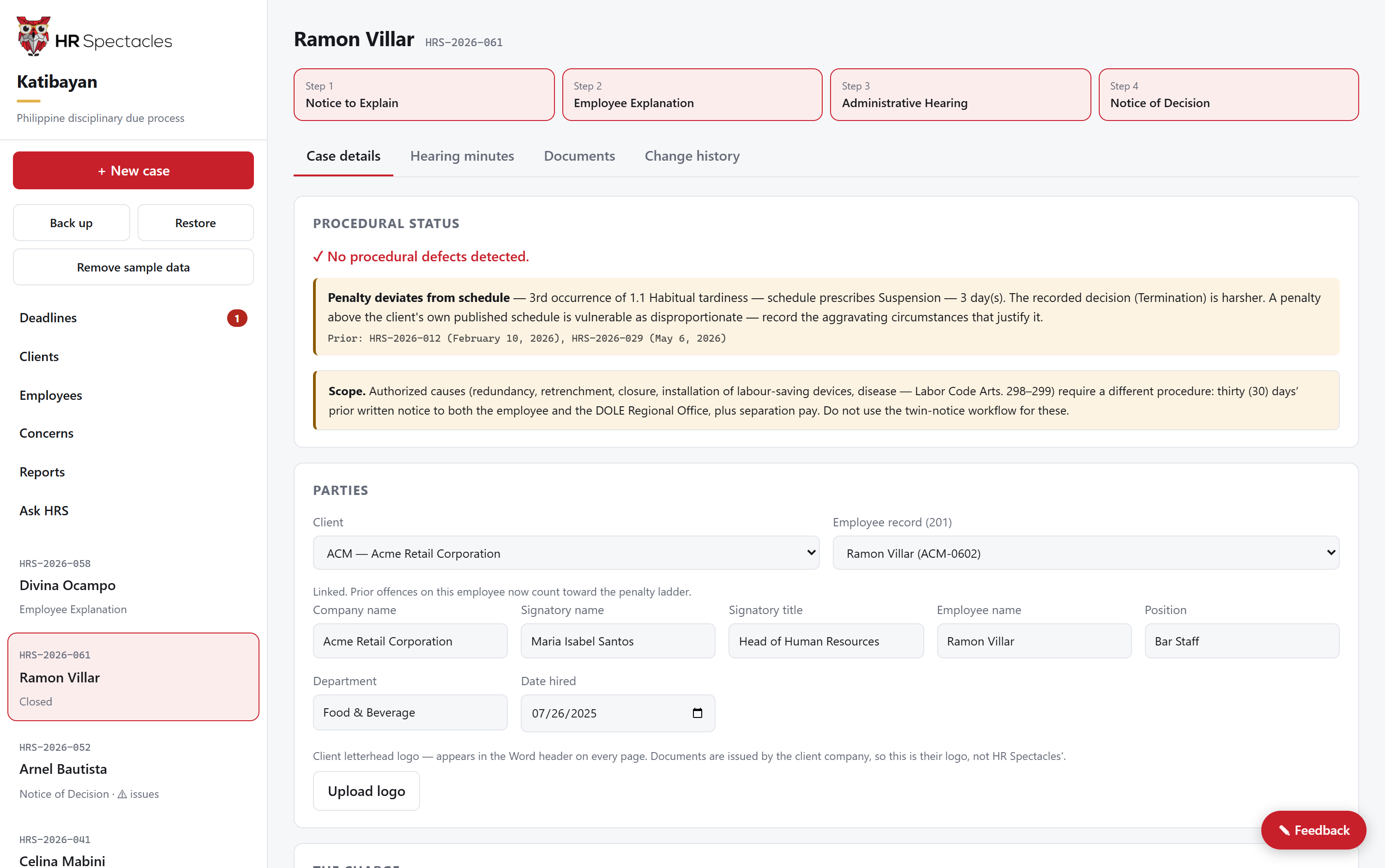
Penalty consistency warning citing prior cases
Third occurrence of habitual tardiness. The schedule prescribes a three-day suspension; the recorded decision is termination. Flagged as disproportionate, with both prior cases cited by reference and date — before the Notice of Decision goes out.
The whole lifecycle

Every statutory clock, one dashboard

Probation to discipline to separation — the deadlines that cost money when they pass quietly, all counting in one place.
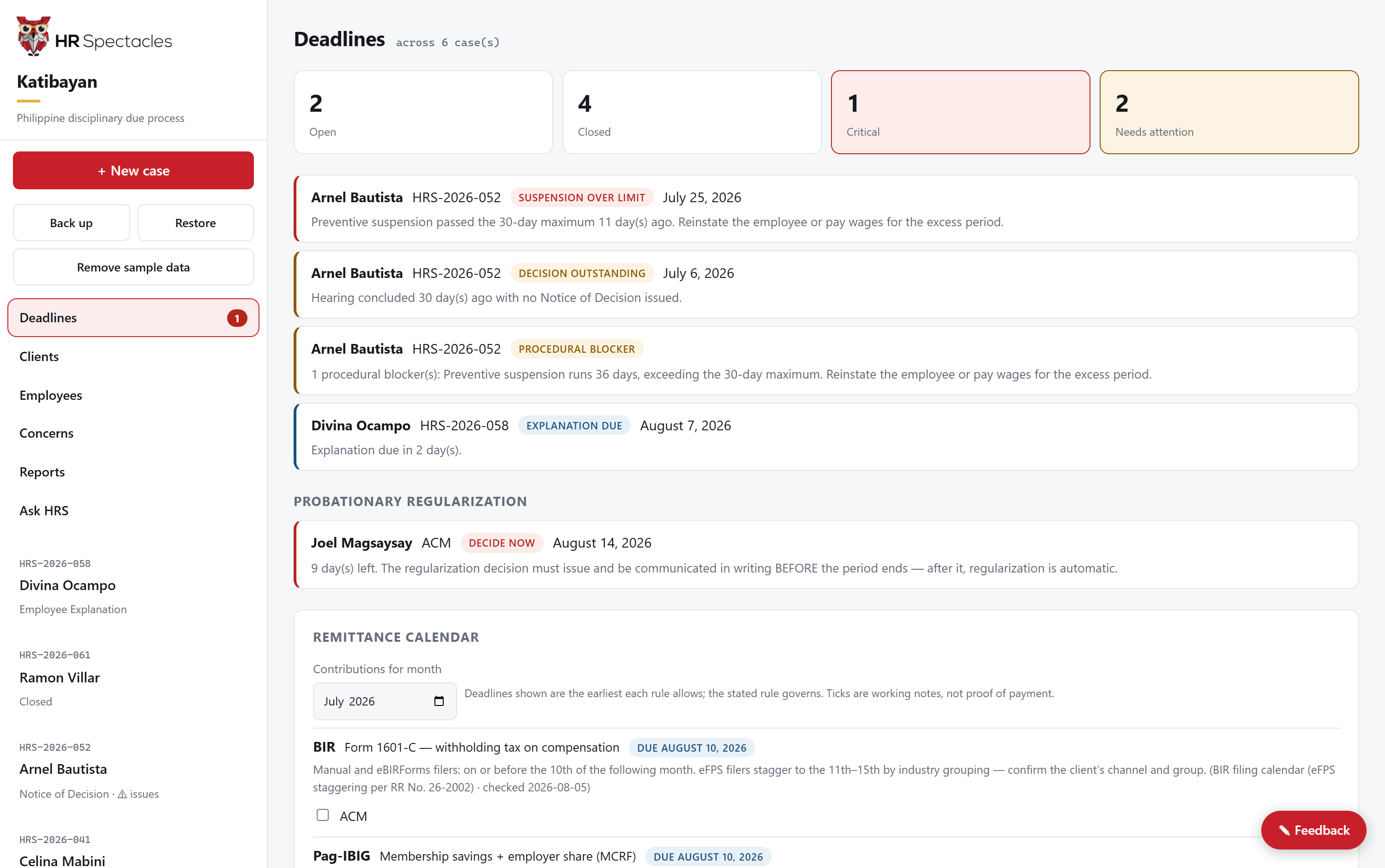
Deadline dashboard across the caseload
Every client at once, critical first. The red alert is a preventive suspension past the statutory maximum — the point at which wages become payable. Below it: probation deadlines, offboarding clocks, and the monthly remittance calendar.
5 daysExplanation period, counted from receipt — decisions issued early are blocked.
30 daysPreventive suspension cap. Past it, reinstate or pay.
6 monthsProbation — counted under BOTH Supreme Court doctrines and alarmed on the earlier, because an employee kept past the line is regular by operation of law. Regularization and non-regularization letters are one click away.
30 + 3 daysFinal pay from separation, COE from request (LA 06-20) — with clearance, quitclaim and COE generated from the offboarding chain.
MonthlySSS, PhilHealth, Pag-IBIG and BIR remittance windows per payroll client, alarmed on the earliest date each rule allows, with the full rule cited beside it.
3 / 14 daysEmployee-concern aging against the service standard — because an ignored concern is how retainer work becomes a SEnA request.
From hearing room to signed minutes

The whole chain, mostly automatic

Zoom records. Katibayan receives it, cleans the transcript, drafts the minutes in your house format, and exports Word.

Automatic
01

Zoom records

Cloud recording fires a signed webhook the moment the hearing ends.

Automatic
02

Per-speaker audio

One track per participant, so who said what is known — not inferred.

AI
03

Transcript cleanup

Fixes what the machine misheard, checked against the attendee list. You accept each change.

AI
04

Minutes drafted

Annex B.9 AH-MOM — with the background and closing prose AI-drafted from case facts only, accepted line by line.

05

Word + PDF out

Client letterhead, real tables, “Page X of Y” — and a print-faithful PDF in your house layout.
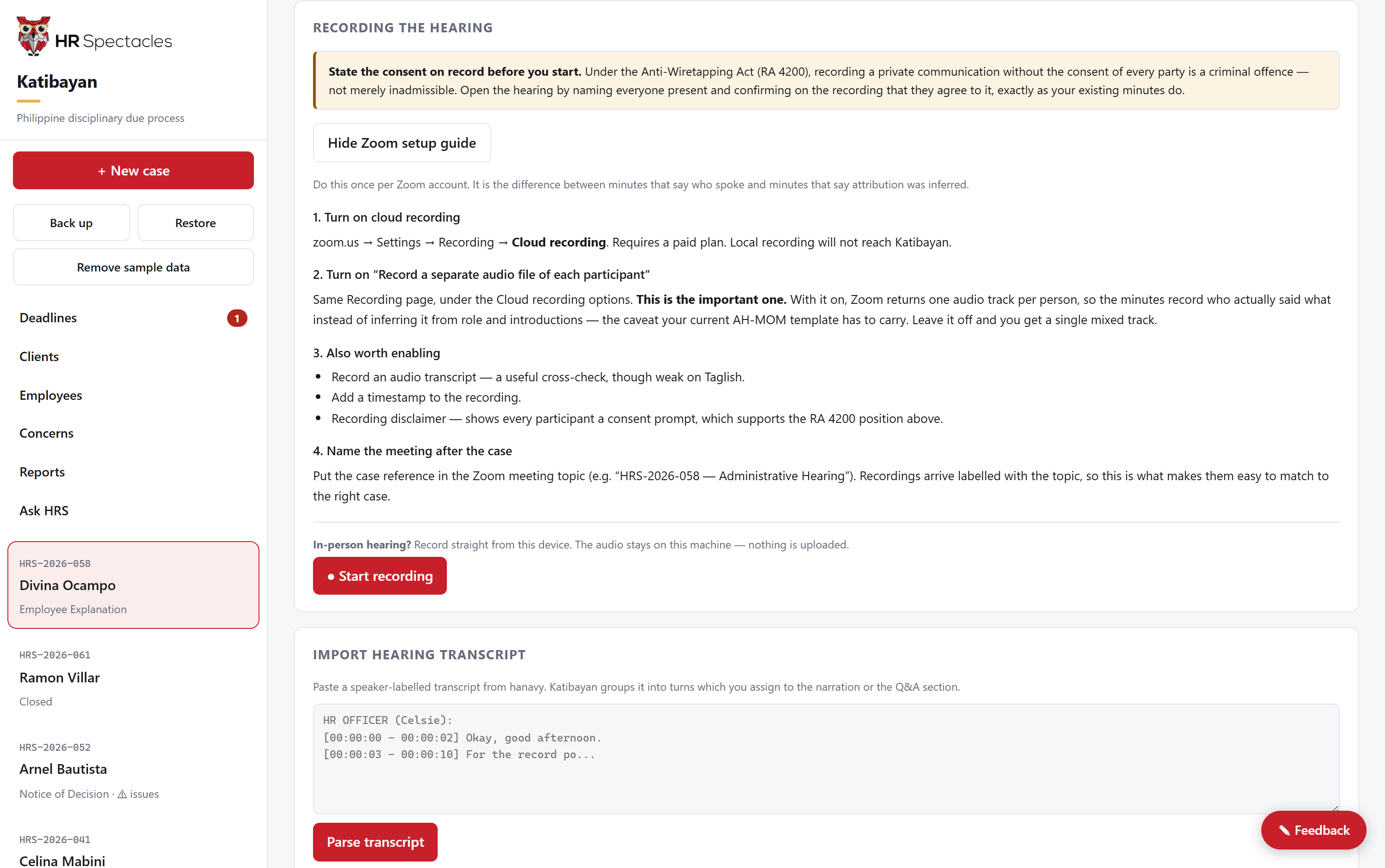
Hearing capture panel with the Zoom setup guide and in-person recording
The setup guide lives in the app, not a manual. One Zoom setting does the real work — “record a separate audio file of each participant” turns speaker attribution from an inference into a fact. In-person hearings record straight from the browser, and both routes lead with the RA 4200 consent step.
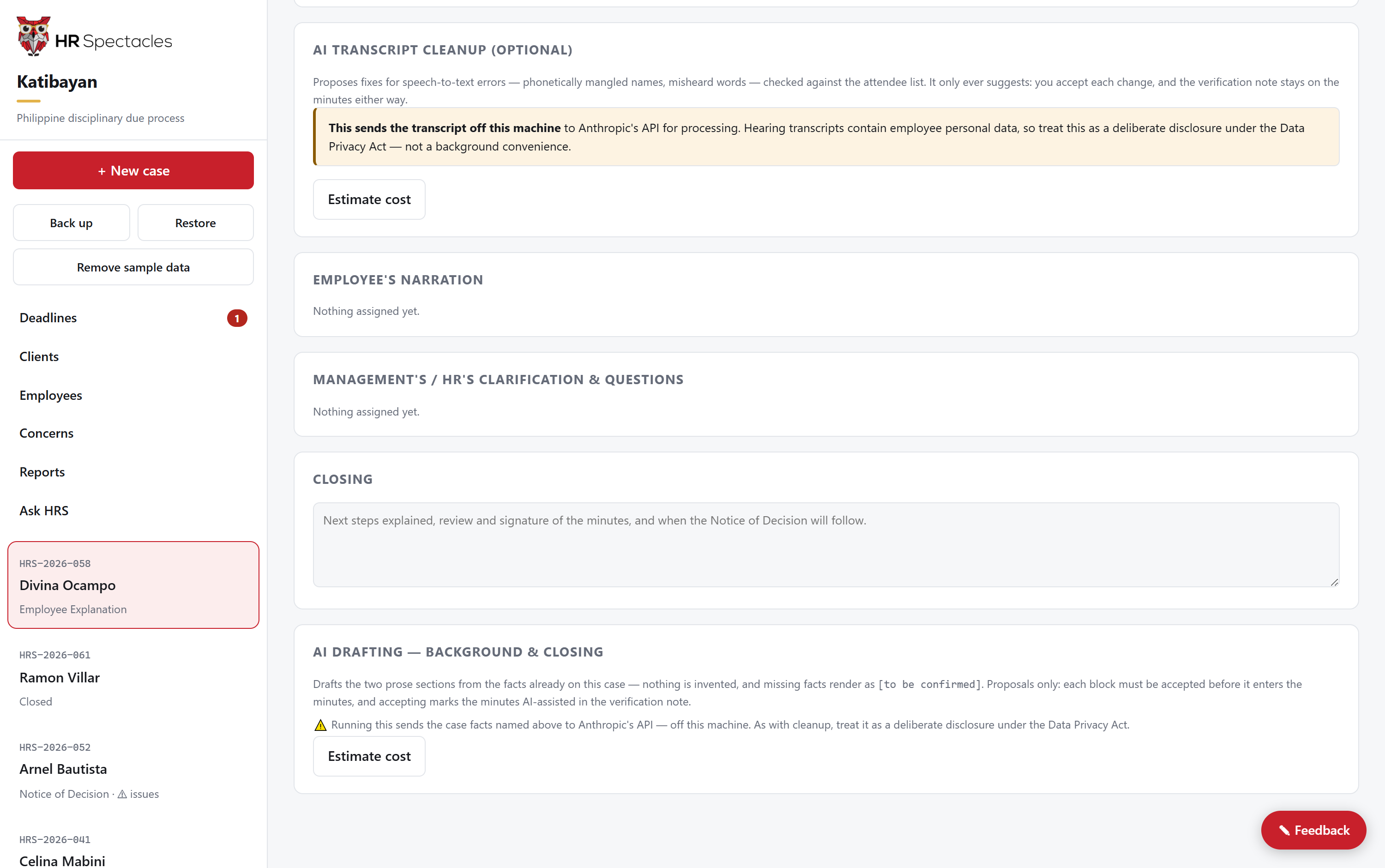
AI transcript cleanup panel showing the privacy notice and cost gate
AI that asks permission and quotes a price. Nothing runs until you press estimate; nothing is applied until you accept each correction individually. It fixes what the machine misheard and leaves what the speaker said alone.
Capabilities

What's actually in it

⚖️

Statutory rules engine

Art. 297, Art. 292(b), D.O. 147-15, King of Kings v. Mamac, the 30-day cap. Every rule carries its citation.

🚦

Blocks defective notices

Fewer than five days, a decision before the period expired, no hearing and no waiver — each stops the document.

📊

Caseload deadlines

Every client at once, critical first, naming the remedy rather than just the problem.

Penalty consistency

Reads the 201 history, works out the occurrence, compares against the client's schedule.

📄

Word + PDF out

Editable .docx with real structure, and a print-faithful .pdf laid out to your house format — no Word round-trip to send or archive.

🎥

Zoom ingest

HMAC-signed webhook, replay-protected. Download tokens never reach the browser.

🎙️

In-person recording

Record from the browser for face-to-face hearings. Audio stays on the device.

🤖

AI, on a leash

Proposes corrections, never applies them. Won't touch grammar, Taglish, or [inaudible].

💰

Cost before you spend

Exact token count and price shown before any AI runs. Routine work routes to a cheaper model automatically.

🔒

Local-first

Case records live in the browser, not on a server. Nothing to breach because nothing is stored.

🗂️

201 registry

Stop retyping employee details. Cases keep a snapshot as at the time, so history stays accurate.

🏢

Client workspaces

One record per client — letterhead, signatory, logo and house wording ("Show Cause Memorandum", their closing, their footer) inherited by every new case. The statutory skeleton stays locked.

📬

Proof of receipt

"I never received the notice" is the cheapest attack on a dismissal. Service method, witnessed refusal, and the signed receiving copy — fingerprinted so a swapped image is detected.

📚

Cited law reference

Dismissal, contributions, wages, filings and privacy — searchable, each entry naming the article, issuance or case.

🛡️

Grounded answers

The AI answers only from the retrieved provisions. Invented citations are detected and flagged, not quietly published.

Probation tracker

An employee kept past six months becomes regular by law. Both counting doctrines tracked, alarmed on the earlier — with the regularization letters one click away.

🚪

Offboarding chain

The 30-day final-pay and 3-day COE clocks (LA 06-20), clearance, quitclaim — deadline-tracked like everything else.

🗓️

Remittance calendar

SSS, PhilHealth, Pag-IBIG and BIR monthly clocks per payroll client, alarmed on the earliest date each rule allows.

📮

Concerns intake

Day-to-day employee concerns logged and aged against a service standard — and the monthly report shows clients the volume absorbed.

🪶

AI-drafted minutes prose

Background and closing drafted from case facts only — missing facts render as [to be confirmed], never guessed. Accepted field by field.

✍️

Feedback built in

A button on every screen that attaches the page, version and case automatically.

Documents

Your format, not a generic one

Three documents, generated from the case record and exported as Word with client letterhead, real tables and page numbering.
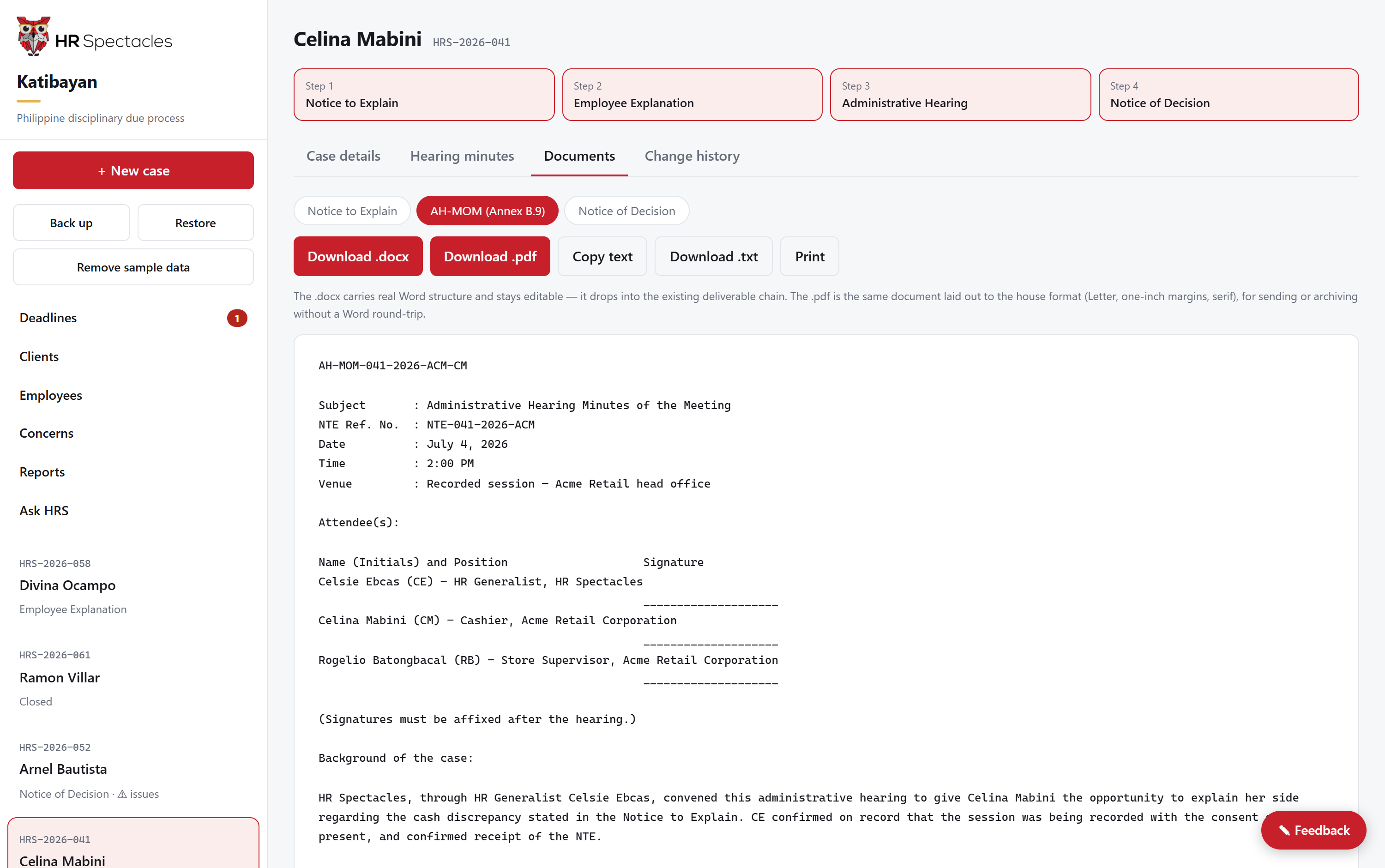
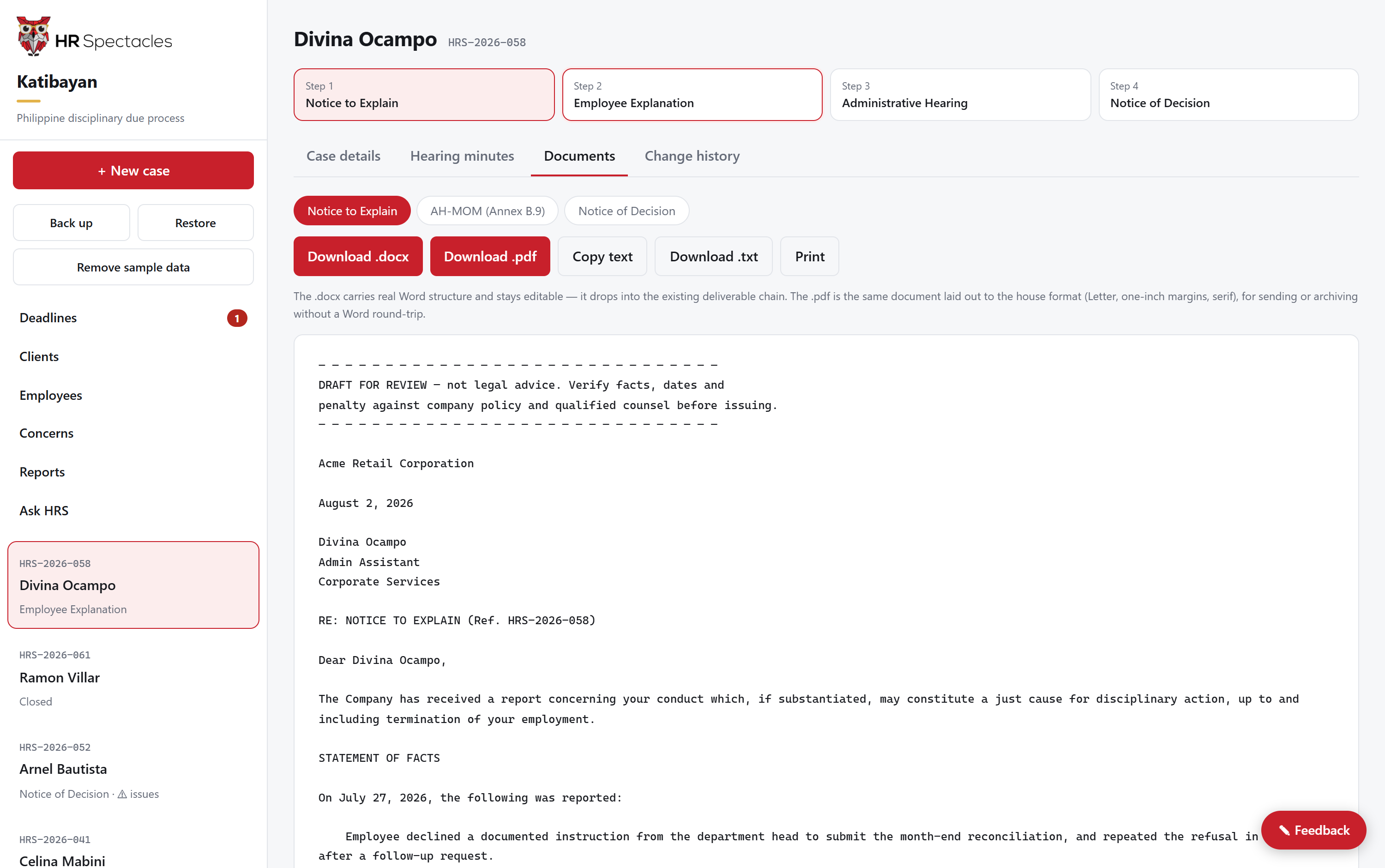
Generated AH-MOM in the Annex B.9 house format
The AH-MOM, in the Annex B.9 layout already in use. Reference block, attendee table with signature lines, employment confirmation, hearing proper, closing, Nothing follows. Where minutes come from a transcript, a verification note discloses it and lists what still needs checking against the audio.
Generated Notice to Explain with export controls
The Notice to Explain carries every element D.O. 147-15 requires — detailed narration, the ground relied upon, the company rule, the five-day directive, the right to a representative, and the statement that termination is a possible consequence.
The 201 file

Prior offences become countable

Which is what makes the penalty ladder work at all.
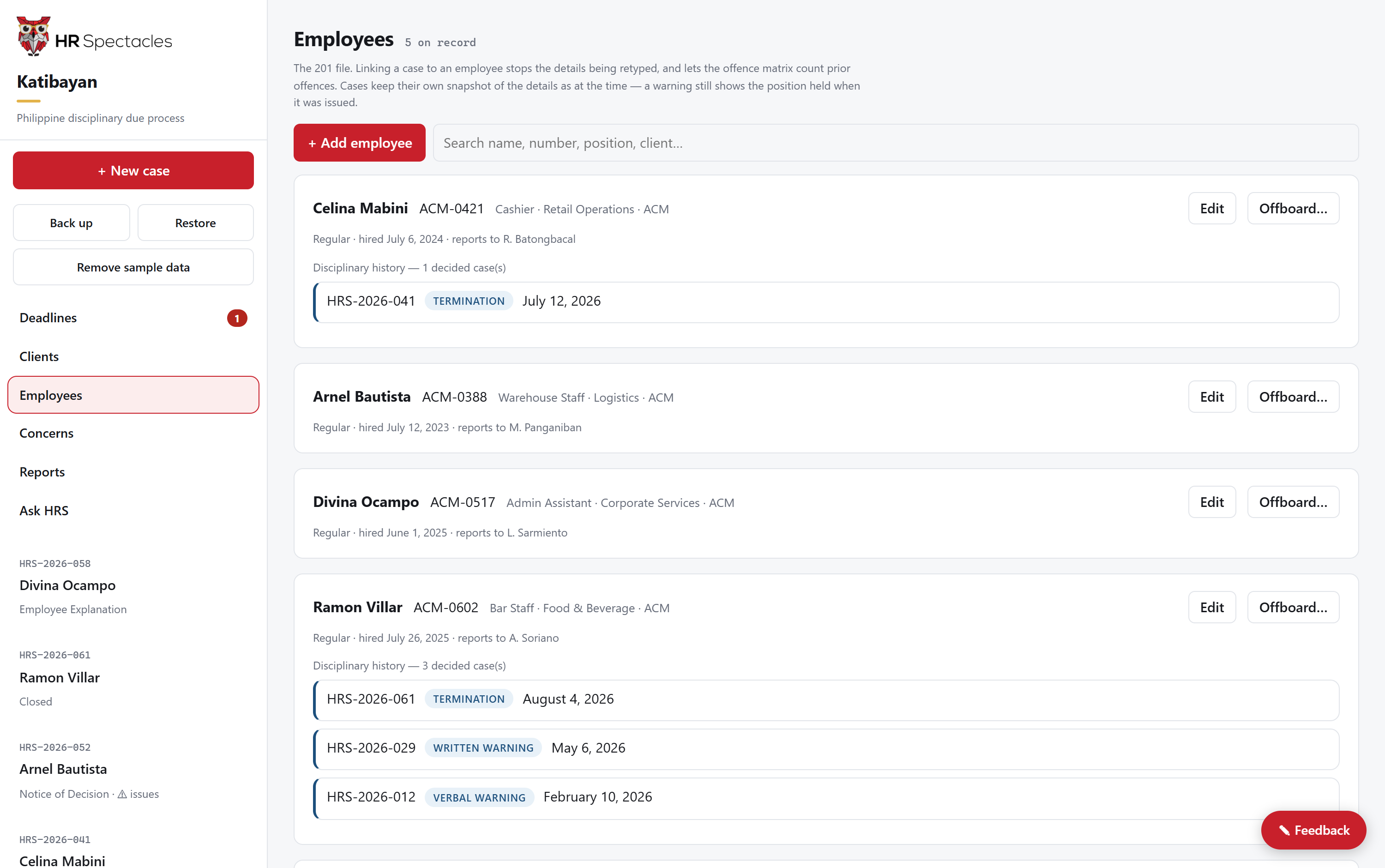
Employee 201 registry with disciplinary history
Each employee's decided history, in one place. Cases keep their own snapshot of the details as at the time — a warning issued two years ago still shows the position held then, not today's.
Change history

"The record was written up afterwards"

The argument that loses an otherwise winnable case. This is the answer to it.
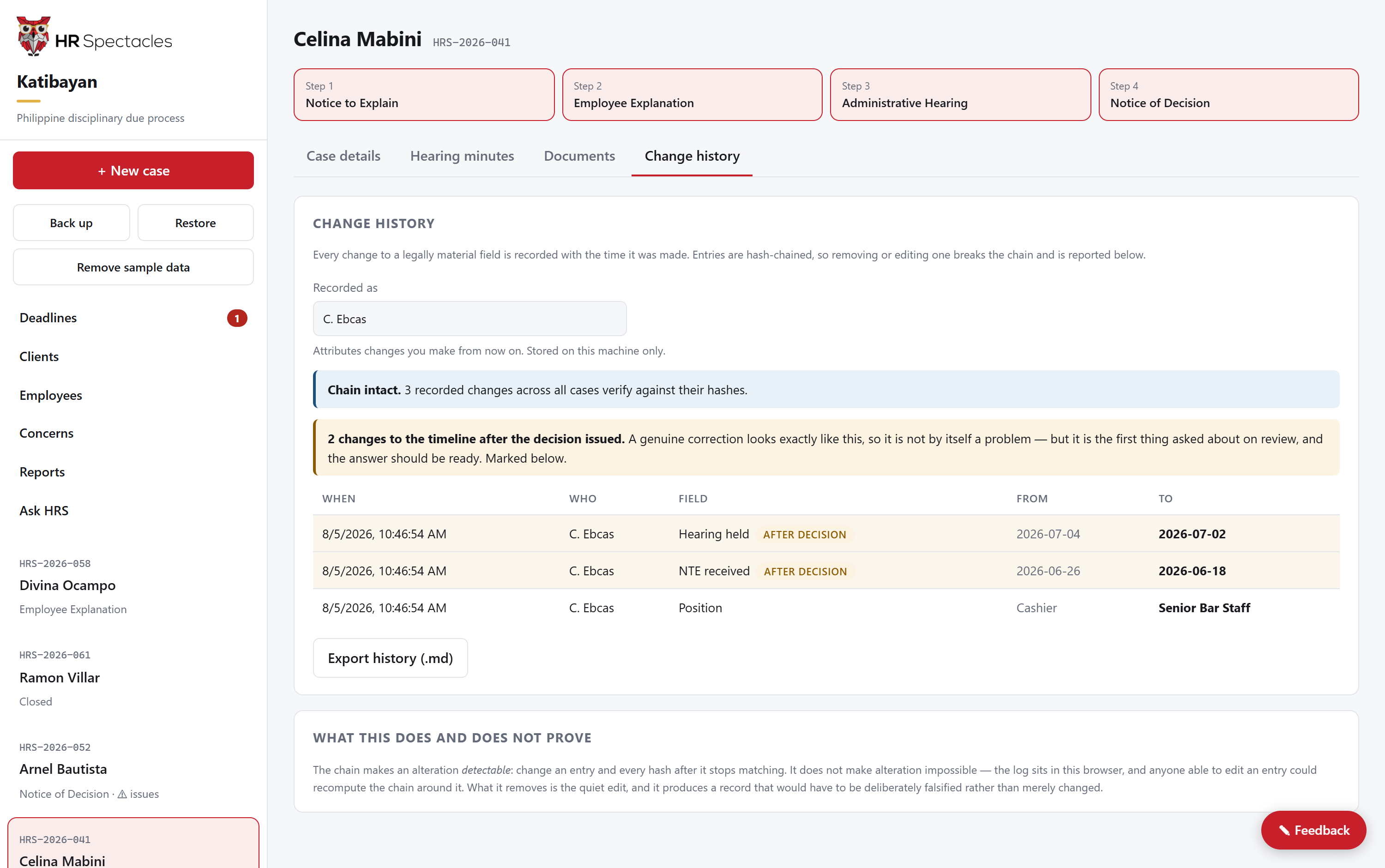
Change history showing hash-chained edits, two flagged as after the decision
Two dates moved after the decision had already issued — flagged, not buried. A genuine correction looks identical, which is the point: it is the first thing asked about on review, so the answer should already be in the file rather than reconstructed from memory.
Every material field, timestampedDates, causes, outcome, penalty, preventive suspension — with who made the change, and what it was before.
Backdating is called out by nameA change to a deadline-driving date after the decision issued is highlighted automatically.
Hash-chainedEach entry commits to the one before it. Edit or delete one and the app says which entry broke and stops trusting everything after it.
It states its own limitsThe panel says plainly that this makes tampering detectable, not impossible. Overclaiming on an evidence tool is how you lose the witness.
Ask HRS

The question a consultant answers for the fifth time this week

A cited labour-law reference built into the tool — and an AI that is only permitted to answer from it.
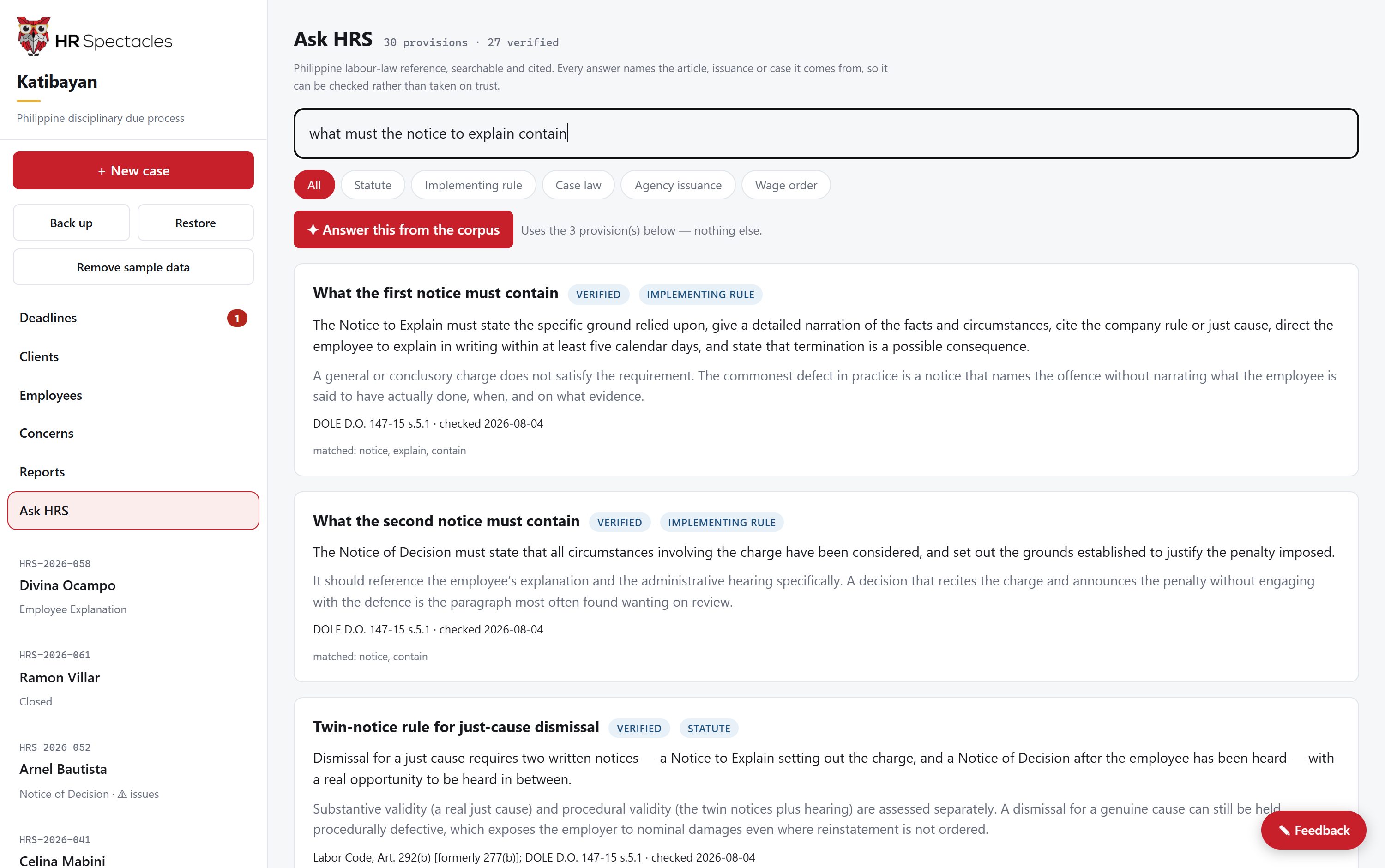
Ask HRS returning cited labour-law provisions with verification badges
Every provision carries its citation and the date it was checked. Search runs on the machine; nothing is sent anywhere until you ask for a written answer, and case data is never part of that.
It cannot answer from memoryThe model is given the matched provisions and instructed to refuse rather than fill a gap from its own training. "The corpus doesn't cover that" is an acceptable answer; an invented rule is not.
Invented citations are caughtEvery reference in an answer is resolved back to a supplied provision. One that doesn't resolve turns red and the answer is flagged unreliable.
It admits what it hasn't checkedEach entry records whether it was verified against a source and when. Answers relying on unverified material say so.
Rates are treated as movingSSS, PhilHealth, Pag-IBIG and wage orders are flagged volatile and go stale on a schedule, so nobody quotes last year's number.
Monthly report

The pack you assemble by hand, generated

Pick a client and a month — the deliverable builds itself from the case records and exports as Word.
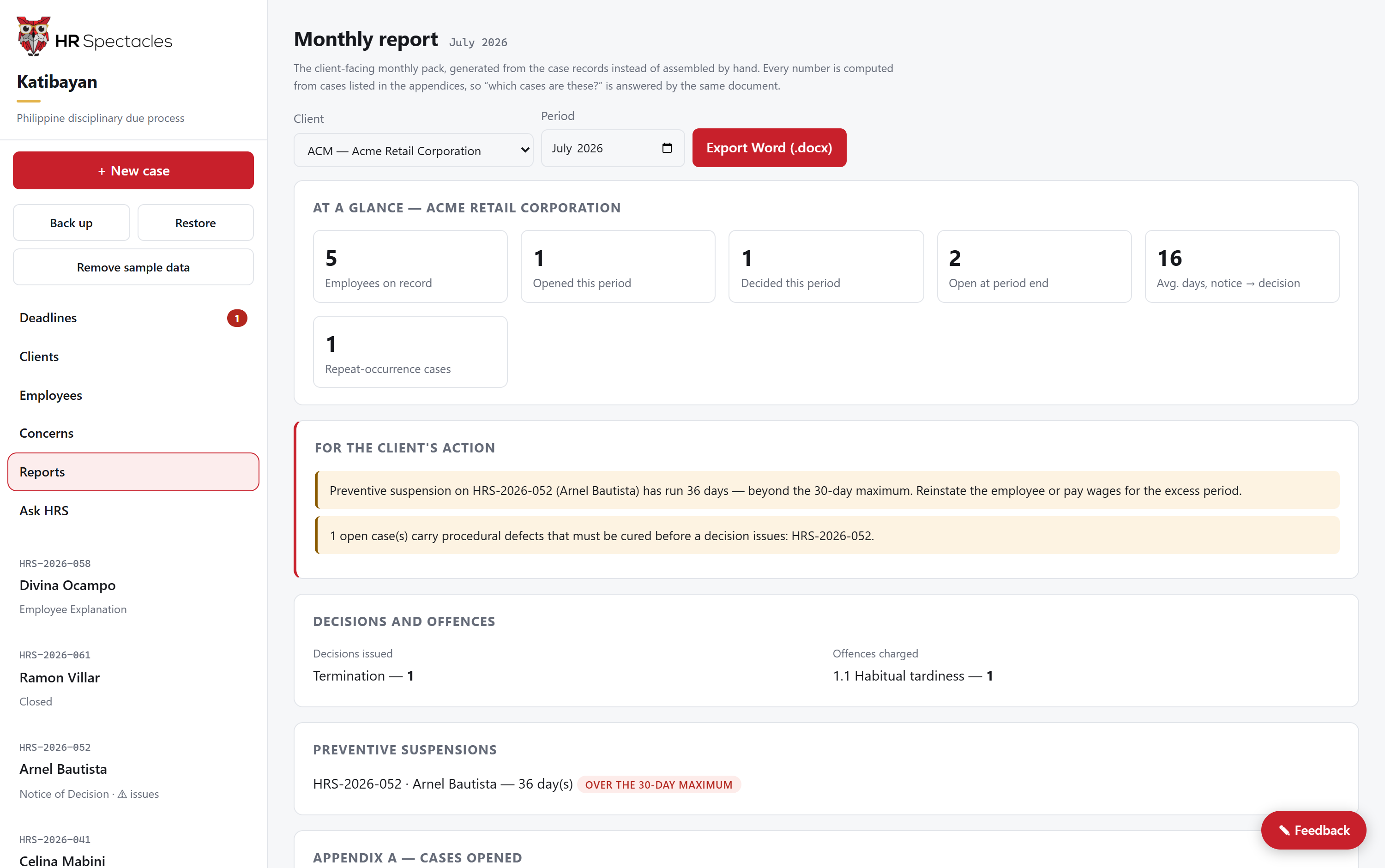
Monthly HR report for a client with action items and an over-limit suspension flagged
Every number is traceable. Caseload movement, outcomes, offences, cycle time, preventive suspensions and the items needing the client's action — each figure computed from cases listed in the appendices of the same document, so “which cases are these?” answers itself.
Billable work, automatedThe monthly metrics pack per client goes from an afternoon of assembly to a button.
Action items in plain sentencesOver-limit suspensions, silently lapsed explanation periods, procedural defects — phrased for the client to act on.
Honest about timeA report run mid-month never asserts a future lapse as fact; deadlines are evaluated as at the earlier of today and period end.
Word out, HRS-brandedPrepared-by-HR-Spectacles header, summary tables, appendices, page numbering — ready to send.
Under the hood

Built to be defended, not demoed

414 automated testsCalendar arithmetic, statutory deadlines, penalty ladders, document output, corpus retrieval, tamper detection, report computation — plus a headless smoke pass on every deploy.
Every rule cites its sourceTraceable from the generated document back to the article or case.
Runs on Cloudflare's edgeNothing to install. Updates reach everyone instantly.
Drafts, never finalThe tool enforces process and deadlines. A practitioner owns the judgement.
Test drive

Four clicks in

1Sign inEnter your email, get a one-time code. No password to set.
2Load sample dataLeft sidebar. Seeds a fictional caseload where every feature visibly fires.
3Open Ramon VillarThe penalty warning. Then Celina Mabini → Documents for the AH-MOM.
4Ask HRSLeft sidebar. Try “preventive suspension maximum” — then change a date on a closed case and open Change history.
5Walk the lifecycleDeadlines shows a live probation countdown and the remittance calendar; Employees → Offboard starts the final-pay clock; Reports builds the monthly pack.

Open Katibayan →

Found something wrong? Say so. The Feedback button sits on every screen and attaches the page, version and case automatically — so a one-line “this is broken” is enough. That is the most useful thing you can do with this build.
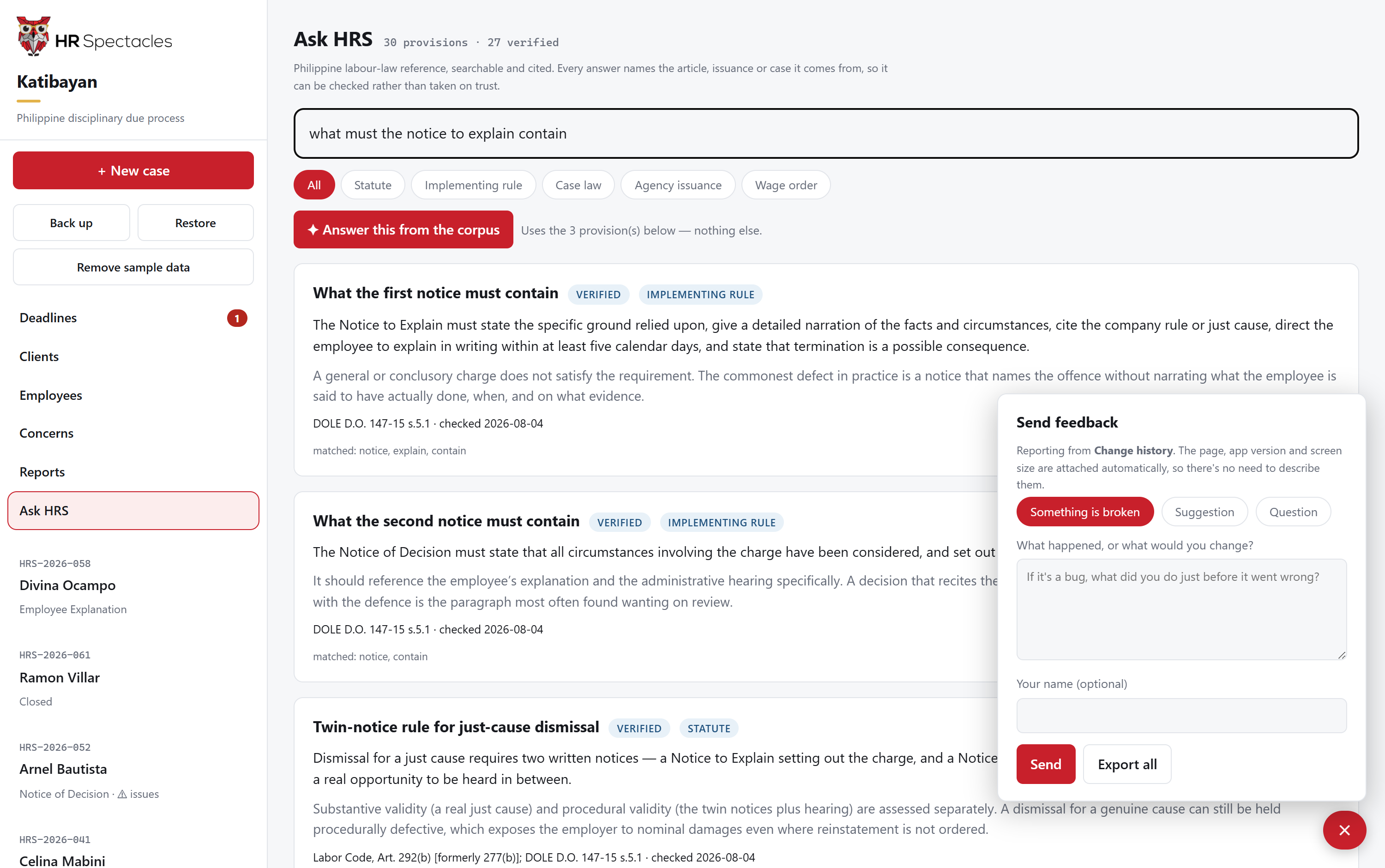
In-app feedback reporter
Reports are saved on your device first, so nothing is lost to a dropped connection — and the screen you were on is attached automatically, so there's no need to describe where it happened.